
A stalled property closing, an unexpected boundary claim, or a contractor’s defective work can become far more than an inconvenience. Property disputes often put valuable assets, business operations, and personal relationships at risk at the same time. The decisions made in the first days of a conflict can affect the available evidence, negotiating position, cost, and ultimate outcome.
The right response is rarely to send an angry message or simply wait for the other side to act. A structured legal assessment helps identify what is actually disputed, what documents control the relationship, and which practical steps protect your position before the conflict escalates.
Why Property Disputes Escalate So Quickly
Real estate disputes are rarely limited to a single issue. A disagreement over a lease may also involve unpaid rent, repair obligations, access to premises, business interruption, and alleged breaches of notice requirements. A construction dispute may concern delays, defects, change orders, payment claims, and the allocation of responsibility among several parties.
The financial stakes also create pressure. A property owner may be unable to sell, refinance, develop, or lease a property while a dispute remains unresolved. A tenant may face operational disruption. A business may be forced to choose between accepting an unfavorable demand and committing resources to a legal process.
Emotions can make matters worse, particularly where neighbors, family members, co-owners, or long-standing commercial partners are involved. Legal rights still matter, but a viable strategy must account for the commercial and personal realities surrounding the property.
Common Types of Property Disputes
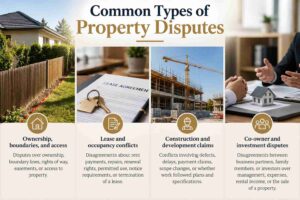
The facts determine the legal approach. Still, certain conflicts appear repeatedly in both commercial and private property matters.
Ownership, boundaries, and access
Ownership disputes can arise from unclear transfers, competing claims, inheritance issues, or errors in property records. Boundary disputes may concern the location of a fence, driveway, retaining wall, or building. Access disputes often involve alleged rights of way, easements, parking rights, or use of shared land.
These matters may look straightforward from the ground, but the legal answer often depends on title documents, recorded rights, surveys, historic use, and the precise wording of earlier agreements. A neighbor’s long use of an area does not automatically create a legal right, just as a recorded boundary does not always resolve every question about access or maintenance.
Lease and occupancy conflicts
Lease disputes frequently begin with a disagreement about payment or condition of the premises. They can quickly expand to questions about renewal rights, notice, permitted use, repairs, alterations, security deposits, subleasing, or termination.
For commercial tenants and landlords, timing is particularly important. An invalid notice or an unexamined lease clause can weaken an otherwise strong position. Before withholding rent, changing locks, terminating an agreement, or removing property, it is wise to understand the contract and applicable legal requirements.
Construction and development claims
Construction-related disputeshttps://advantage.se/abt-06-legal-advice-construction-disputes/ may involve alleged defective work, delayed completion, unpaid invoices, scope changes, or disagreements about whether work complied with plans and specifications. Developers, owners, contractors, and subcontractors may each point to a different contract provision and a different version of events.
Documentation is often decisive. Signed change orders, site reports, photographs, inspection records, emails, invoices, and schedules can establish whether the work changed, who approved it, and whether notice was given on time. Where defects are alleged, an independent technical assessment may be as important as the legal analysis.
Co-owner and investment disputes
Property held by business partners, family members, investors, or joint ventures can create difficult questions when interests no longer align. One party may want to sell while another wants to hold. Disputes may arise over management, expenses, improvements, rental income, refinancing, or the value of a buyout.
A shareholder agreement, partnership agreement, or co-ownership arrangement may provide the answer. If the documentation is incomplete, the parties may need to rely on broader principles of property, contract, and company law. This is where an early review can prevent a disagreement from becoming a deadlock.
What to Do When a Property Dispute Begins
The immediate goal is to protect your position without taking a step that creates additional exposure. Start by preserving the record. Save contracts, amendments, correspondence, payment records, photographs, plans, inspection reports, meeting notes, and relevant messages. Avoid editing documents or relying only on memory when events are still developing.
Next, establish a clear timeline. Identify when the agreement was made, when work was performed, when access changed, when payments became due, and when notice was sent or received. A chronology often reveals missed obligations, inconsistent statements, and deadlines that deserve urgent attention.
It is also sensible to limit informal communication. You do not need to stop communicating altogether, especially if an ongoing business relationship requires cooperation. But written communications should be accurate, measured, and consistent with the position you may later need to explain to a court, arbitrator, authority, lender, or insurer.
Do not assume that a demand from the other party is correct simply because it is forceful. At the same time, do not disregard a formal notice, claim, or deadline because you believe the allegations are unfair. Some rights can be lost if a response is late or if a contractual notice procedure is not followed.
Resolve the Conflict Without Giving Up Leverage
Many property disputes can be resolved through direct negotiation, settlement discussions, mediation, or another agreed process. A negotiated solution can preserve value, shorten disruption, and provide outcomes a court may not be able to order. For example, the parties may agree on a repair plan, revised completion schedule, buyout, access arrangement, payment plan, or lease amendment.
Settlement is not always the right answer. If the other party is unwilling to cooperate, if a key legal principle must be determined, or if delay is causing serious damage, formal proceedings may be necessary. The point is not to avoid litigation at all costs. It is to choose a process that reflects the evidence, legal position, financial exposure, and business objective.
A strong negotiating position comes from preparation. When you can explain the facts, identify the controlling agreement, quantify the loss, and show that you are ready to pursue the matter if needed, discussions tend to become more productive. Threats without analysis usually have the opposite effect.
When Litigation Becomes Necessary

Court proceedings may be appropriate where negotiations fail, where urgent relief is needed, or where the other side refuses to honor a clear obligation. Litigation can establish rights, recover damages, enforce payment, stop unauthorized conduct, or determine responsibility for defects and delays.
However, litigation requires discipline. The parties must evaluate the likely legal arguments, available proof, procedural deadlines, legal costs, recovery prospects, and effect on the underlying property or business. A case can be legally sound but commercially unwise if the likely recovery is limited or enforcement will be difficult. Conversely, a prompt legal action may prevent a much larger loss where a property transaction, development project, or tenant relationship is at risk.
Experienced counsel can assess whether interim measures, expert evidence, a formal demand, mediation, or court action provides the best route forward. Advantage works with clients to turn complex disputes into a clear action plan, while keeping both legal rights and practical business objectives in view.
Reduce the Risk Before the Next Dispute
The best time to address a property conflict is often before it exists. Clear contracts should define the property, permitted use, payment terms, maintenance duties, approval procedures, notice requirements, dispute-resolution process, and consequences of breach. In construction and development arrangements, scope, schedules, specifications, change orders, acceptance criteria, and responsibility for delays deserve particular attention.
Good documentation also matters after the agreement is signed. Keep records organized, confirm significant decisions in writing, and address warning signs early. If a tenant stops paying, a contractor falls behind schedule, or a co-owner begins acting outside the agreed arrangement, waiting may increase the cost and narrow the available options.
A property dispute does not need to dictate the future of your home, investment, or business. Prompt advice, careful evidence management, and a strategy tied to your real objective can create room for a practical resolution or put you in a stronger position to pursue the matter formally.