
An insurance denial can arrive when a business or family is already dealing with a loss, injury, damaged property, or interrupted operations. A guide to insurance policy disputes begins with a practical point: the insurer’s first position is not always the final outcome. Coverage often turns on precise policy language, the quality of the evidence, and how quickly the policyholder responds.
For a homeowner, the dispute may concern water damage, fire loss, disability benefits, or an uninsured motorist claim. For a business, it may involve property damage, professional liability, product claims, cyber incidents, business interruption, or directors and officers coverage. The financial stakes can be significant in either case. Early, organized action helps preserve options and puts the policyholder in a stronger position to seek a fair result.
What creates an insurance policy dispute?
An insurance dispute does not always begin with an outright denial. It may start when an insurer reserves its rights, requests repeated documentation, offers an amount that does not cover the loss, delays a decision, or accepts only part of a claim. Those positions can be justified in some circumstances, but they should be tested against the policy and the facts.
Most disputes fall into one or more of these areas: whether the event is covered, whether an exclusion applies, whether notice was timely, how the loss should be valued, and whether the policyholder complied with post-loss obligations. In commercial claims, disputes may also arise over the definition of a covered interruption, causation, additional insured status, or the insurer’s duty to defend a lawsuit.
Policy wording matters, but it is rarely the only issue. A single defined term can affect the outcome, yet so can the timeline of events, prior communications, repair records, expert opinions, and statements made during the claim process. That is why a broad reading of a denial letter is not enough. The reasoning must be compared carefully with the entire policy, including endorsements and declarations.
Start with the policy, not the adjuster’s conclusion
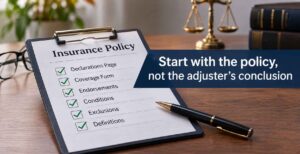
Insurance policies are detailed contracts, often assembled from a declarations page, core coverage form, endorsements, conditions, exclusions, and definitions. The declarations page identifies the coverage limits and insured parties, but it does not provide the full answer to a coverage question.
Request a complete and current copy of the policy if you do not have one. Confirm that all endorsements are included, particularly those issued at renewal. An endorsement may expand, restrict, or replace language in the main form. In business insurance, it is also worth confirming whether separate policies may respond to the same incident, such as property, general liability, cyber, or umbrella coverage.
Focus on the insurer’s stated reason for its decision. If it relies on an exclusion, identify the exact exclusion and read it alongside the coverage grant and relevant definitions. If it alleges late notice or insufficient cooperation, review the applicable condition and document what notice and information were provided. Policyholders should avoid assuming that an insurer’s interpretation is the only reasonable one.
Preserve the facts while the claim is still active
Evidence is easiest to lose in the first days and weeks after a loss. Damaged materials may be removed, witnesses’ memories fade, and repair work can make the original condition difficult to establish. At the same time, reasonable steps to prevent further damage are often required under the policy. The key is to document before repairs or disposal take place whenever possible.
Create a claim file containing the policy, claim number, photographs and video, estimates, invoices, inspection reports, relevant contracts, and every email or letter with the insurer. Keep a dated log of phone calls that records who participated, what was discussed, and any next step promised. For a business interruption claim, retain financial statements, sales records, payroll data, tax documents, supplier communications, and proof of mitigation efforts.
Do not alter, discard, or repair key evidence without considering whether the insurer needs an opportunity to inspect it. If emergency work is necessary, document the condition first and keep records of why the work could not wait. This protects both the property and the integrity of the claim.
Be precise in written communications
Respond to reasonable information requests promptly, but do not guess or make broad statements simply to move the process forward. If information is not yet available, say so and provide a realistic date for a response. Ask the insurer to identify any missing documents, disputed facts, or policy provisions it believes are relevant.
Written communication should be factual, calm, and specific. A clear record can be valuable if the dispute later proceeds to an internal appeal, mediation, appraisal, arbitration, or litigation. It also helps prevent misunderstandings when different adjusters become involved.
Challenge a denial or low valuation strategically
A denial letter should be reviewed for both what it says and what it omits. Some letters address only one possible basis for denial, while others reserve additional rights. A well-prepared response addresses the actual reasons given, identifies supporting evidence, and requests a reconsideration where appropriate.
When the dispute concerns the value of property damage, the issue may be less about coverage and more about scope, repair method, depreciation, replacement cost, or the cost of code-compliant work. Independent estimates and qualified expert opinions can be decisive. The lowest repair estimate is not automatically the correct measure of loss, especially where it does not restore the property to its pre-loss condition or overlooks necessary related work.
In liability claims, an insurer’s duty to defend can be distinct from its ultimate duty to pay damages. A company or individual who has been sued should provide the claim materials promptly and seek advice before taking steps that may affect defense rights. Agreeing to a settlement, admitting liability, or incurring major expenses without considering policy conditions can create complications, even where coverage may otherwise exist.
Know the dispute-resolution options

The right next step depends on the policy, the amount at stake, the evidence, and the governing law. Some policies contain appraisal provisions for disputes over the amount of loss. Appraisal can be efficient when coverage is accepted but valuation remains contested. It is generally less useful when the parties fundamentally disagree about whether the policy covers the loss at all.
Mediation can allow the parties to resolve a claim without the cost and delay of a court case. It may be particularly effective where factual uncertainty or business relationships create room for compromise. Arbitration clauses may also apply, although their scope and enforceability depend on the policy and jurisdiction.
Litigation may be necessary when the insurer maintains an incorrect coverage position, refuses to pay a supported claim, or when deadlines require decisive action. In some states, an insurer’s conduct may give rise to additional claims for bad faith or unfair claims practices. Those claims are highly fact-specific, and the applicable standards vary considerably by jurisdiction.
Do not overlook deadlines and settlement terms
Insurance claims involve multiple timelines. The policy may require prompt notice, submission of a proof of loss, participation in an examination under oath, or commencement of legal action within a stated period. State law can affect whether and how those provisions apply, but waiting to investigate can put important rights at risk.
Settlement offers also deserve careful review. A payment labeled as final may require a release of further claims. Before accepting, confirm whether the amount covers all known damage, future repair costs, lost income, legal expenses, and any remaining portions of the claim. If only part of the claim is undisputed, ask whether payment can be made without waiving the right to pursue the remainder.
When legal guidance adds value in insurance disputes
Professional advice is especially useful when the insurer cites an exclusion, the loss involves substantial value, a lawsuit has been filed, several policies may apply, or the claim has become stalled. Counsel can evaluate the policy as a whole, organize the evidentiary record, communicate with the insurer, and advise on the most proportionate route to resolution.
At Advantage Advokatbyrå, the approach to disputes is practical and client-focused: understand the business or personal consequences of the claim, assess the legal position early, and pursue a strategy that matches the risks and objectives. Not every disagreement requires a court case, but every serious denial deserves a careful response.
A claim file that is complete, timely, and grounded in the actual policy terms gives the policyholder more than paperwork. It creates the foundation for an informed decision about whether to negotiate, escalate, or move forward with confidence.